

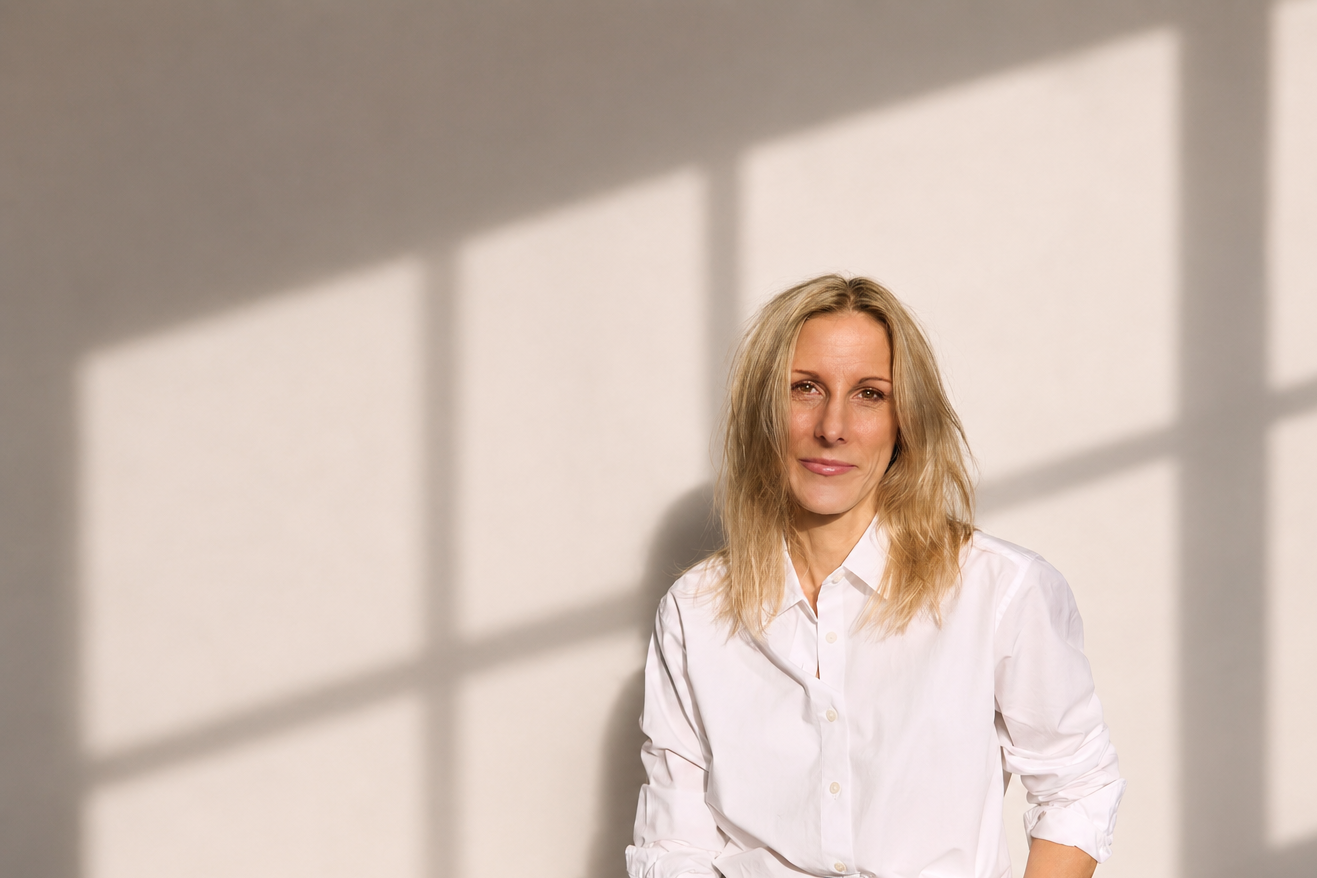
Well, Hello. Welcome, I’m Kate
Meeting you exactly as you are, with curiosity, care, and collaboration.
The heart of my therapy work
My approach is shaped by what it means to settle in yourself - meaning, how to live with authenticity, open-heartedness, and courage as you meet life’s challenges.
Why settled?
Settled doesn't mean calm. It doesn't mean we’re sorted or have everything figured out.
To me, it’s closer to this: being able to stay with your experience as it is, in the moment - tuning in, listening, and feeling it.
It means to stay with the shaky ground when everything in you wants to run.
To stay with the tender, throbbing place that opens up when things fall apart. To stay curious, open-hearted, and OK-enough with not knowing, before rushing to make sense of it all.
Life comes together and it falls apart over and over. Making room for all of the grief, the relief, the misery, and the joy is what feeling settled means to me.

“The more we try to change ourselves, the more we prevent change from occurring. On the other hand, the more we allow ourselves to fully experience who we are, the greater the possibility of change.”
Dr Laurence Heller, Healing Developmental Trauma
How this shapes my work
In therapy, we explore what it’s like to be you - through your lived experience and the ever changing story of you.
Curiosity & Care
At the heart of my work is care. I believe the ways we adapt, protect ourselves, and keep going are expressions of care. Over time, what helped us cope, belong, and stay connected can begin to feel limiting, and somehow out of sync.
Rather than asking what's wrong, we become curious about what these patterns have been protecting, and whether they still serve us today.
Curiosity about how we want to live and why, and care in understanding how we get in our own way, is where care meets curiosity.
Collaboration
Therapy is a dynamic encounter between two people with a shared mission - to explore your lived experience, and what matters to you.
So every therapeutic relationship has its own rhythm. What stays the same is the frame: we pay attention to what's said and what’s unsaid, and how your body communicates what words can't quite reach.
What matters most is a relationship built on trust, respect, and genuineness.
Adaptation
To adapt is human. To like things to feel familiar is also human - and this is the paradox that often brings us to therapy.
At its heart, therapy offers an opportunity to get to know ourselves more intimately. To meet every part of who we are, and coming to see how each of these parts work as a whole. Not rushing to ditch or fix the parts that can feel more than a little challenging …
We get curious about what more autonomy, self-trust, and connection may offer. The goal is not to become a new you - but to expand your capacity to feel more like you.

“When things fall apart and we're on the verge of we know not what, the test for each of us is to stay on that brink and not concretize ... Things are always in transition, if we could only realize it.”
Pema Chödrön, When Things Fall Apart
Therapeutic anchors
My approach is trauma-informed, integrated, and inclusive to make sure every part of you feels seen and held.
Relational
Our earliest relationships shape our sense of Self and other. These attachments teach us how to connect, when to disconnect, and what feels safe - relational patterns that live on long after they were formed.
In therapy, we explore how you might relate to yourself more authentically, and develop a secure way of relating to others - whatever the relationship.
Embodied
Our connection to our life's energy often feels distant. Stress, emotions, and protective patterns live in our body, in the tension we carry, the breath we hold, the tears we prevent from falling, and the feelings we keep at a distance.
In therapy, we pay as much attention to what it's telling us as we do to a belief, a thought, or a pattern of behaviour.
Existential
This philosophical lens sees the humanity in our individual condition. It asks the big questions - how we make meaning, how we meet uncertainty and make choices, and how we relate to the life we are living in the face of ambiguity, anxiety, and the challenges our existence throws at us.
It is a worldview and an ethical stance, one that frames my therapeutic approach.
Training, Certification & Professional Grounding
Working ethically in private practice
I am registered with the British Association of Counselling and Psychotherapy (BACP) with post-graduate training in trauma-informed somatic therapy and nervous system regulation.
I trained in Nervous System Regulation strategies with Linda Thai, one of the world's leading trauma-informed somatic therapists, and in NeuroAffective Relational Model (NARM) at the Complex Trauma Training Institute. I attend group consultations with NARM’s founder, Dr. Laurence Heller, and clinical training with Ralf Marzen.
I am supervised by a UKCP attachment-based psychotherapist whose clinical experience supports my practice - and have had both existential, attachment-focused, and body-based personal therapy over a number of years.
-
Registered Member, British Association of Counselling and Psychotherapy (Professional Standards Authority Accredited). MBACP Register number 416929. Insured with Everywhen.
-
MA, Psychotherapy and Counselling, Regent's University London
Diploma in Integrative Psychotherapy and Counselling, Regent's University London
Certificate in Integrative Psychotherapy and Counselling, Regent's University London
Post Graduate Certificate in Mindfulness-Based Approaches, Bangor University
-
Certificate in Somatic Embodiment and Regulation Strategies (Levels 1-8), Linda Thai
NeuroAffective Relational Model Therapist Training (Module 1), Trauma Training Institute
CPD: Mentalization-Based Treatment, Anna Freud Centre
CPD: Working with the Disembodied Psyche, Susie Orbach
CPD: Building Better Boundaries, Terry Real
CPD: Attachment Theory in Clinical Practice, The Bowlby Centre
CPD: Trauma Informed Stabilisation Programme, Janina Fisher
-
I work ethically and within my experience. Your wellbeing comes first, which is why I have clinical supervision and my own personal therapy. You're protected through professional indemnity insurance and the standards that BACP registration demands. I'm honest about our work and we mutually sign a contract outlining our working agreement. What we discuss stays private, except where there is serious risk of harm. If that arises, we talk about it together first.
a personal note about me
I've been curious about life's big questions for as long as I can remember. In my twenties, life pushed me to ask myself some of the biggest.
Somehow, I stumbled upon a meditation centre. I had nothing to lose from giving it a go as I was very lost and very confused. Since then, I've found Buddhist philosophy quietly comforting and wildly liberating - and have meditated ever since. Sometimes more. Sometimes less.
Psychotherapy offered a home for everything I'd unknowingly been moving towards. Before qualifying, I worked in music, TV, branding, and startups. I have a particular affinity for performers, artists, and entrepreneurs, and the struggles that path seems to throw up.
If I had to chose one perspective that impacted my relationship to life and living, it would be the question the poet Mary Oliver offers us in the last line of The Summer Day …
“Tell me, what is it you plan to do with your one wild and precious life?”